Travel is back with a bang. And so is the rude behavior that sometimes hitches a ride.
With the recent surge in air travel, unruly travelers have shown up in full force. Some recent viral moments: A man raging on board an aircraft about a crying baby and another passenger being so argumentative with flight attendants that United Airlines
UAL,
had to turn a plane around.
In 2021, there was a 492% increase in the number of unruly travelers reported by flight crews, according to the Federal Aviation Administration, with nearly 6,000 reports filed. In 2022, that number fell to 2,455 — a nearly 60% drop — but the total number of complaints was still double what flight crews saw in 2020 and 2019.
There are many theories about why there has been so much bad behavior on flights in recent years. The stress of the pandemic has taken a toll on people’s mental health. Some people felt aggrieved about having to wear masks during the worst days of COVID-19, while other passengers got upset if their seatmate chose not to wear a mask. Being cooped up in cramped quarters during a pandemic also may have led to people feeling on edge and acting out.
Notwithstanding sudden outbursts from passengers, how can travelers have the smoothest, least eventful journey possible, from the moment they check their bags at the airport to when they get off the plane at their destination? Don’t drink too much alcohol before getting on a flight, don’t take off your shoes and socks on the plane and don’t freak out if someone else decides to wear, or not wear, a mask. (These are a few Flying 101 tips to get the ball rolling.)
“You don’t need to wave your passport around every time you meet an airport or airline worker. ”
Among the tips from airport and airline workers: Tuck that passport away, but make sure you know where you’ve put it, after it’s been checked. You don’t need to wave it around every time you meet an airport or airline worker. You only need it when you check in, at the security checkpoint, at the gate when you’re boarding if you’re flying internationally and at immigration if you are arriving from another country.
“Very often, passengers will hurriedly place their passports somewhere and cannot locate them quickly,” a Transportation Security Administration employee said. In the vast majority of cases, it’s usually in a pocket or bag where the traveler doesn’t recall putting it. This can be stressful, holding up the line and frustrating everyone around you.
MarketWatch spoke with the TSA and the Association of Flight Attendants, a trade union. Here are their biggest gripes.
Dress for success
With roughly 2 million passengers making their way through TSA checkpoints on a daily basis, the lines often seem endless. Plus, having to disrobe and re-robe, particularly if you have mobility issues or are traveling with small children, can be downright frustrating. Don’t fret — TSA workers know this. Their top tip for passengers? Dress for success.
The key is to make sure you’re wearing simple clothes when you go through security screening, Eric Guthier, a uniformed adviser to executive leadership at the TSA, told MarketWatch. “Screening technologies may generate false alarms on clothing with excessive sequins, laces and metal, such as the metal buckles on overalls and suspenders,” he said.
At the same time, keep small jewelry like earrings and rings on, as those do not need to be removed before you go through a security screening, Jeanine Lacayo, a Roanoke, Va.-based supervisory transportation security officer, told MarketWatch.
“Small jewelry does not usually create an alarm on our screening technologies, and we absolutely do not want passengers to lose their valuables,” Lacayo said. In fact, the most common lost jewelry at security checkpoints are rings, earrings and watches. And it takes time to help each passenger search for them, she added.
Plan, plan, plan
Did you know that rush hour at some airports is between 5 a.m. and 7 a.m.?
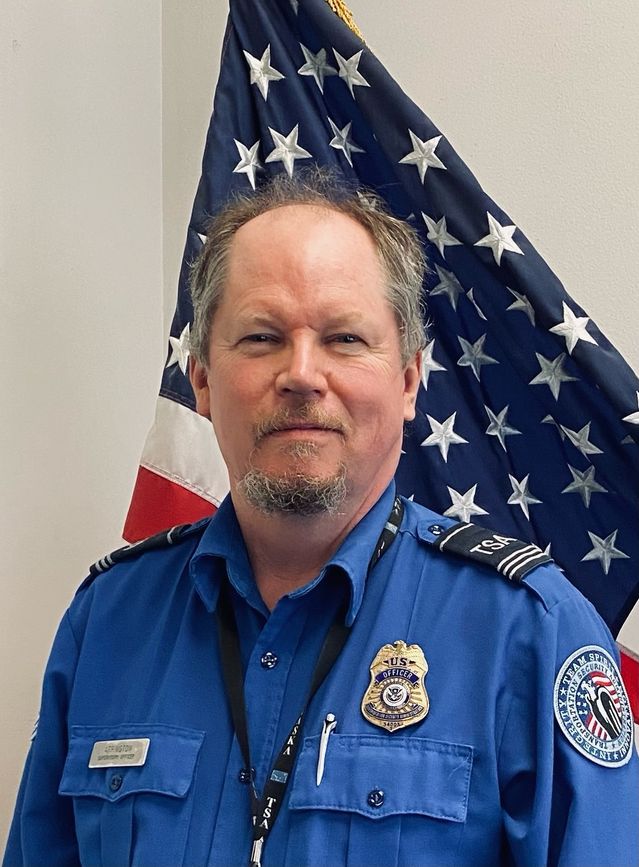
“Just as highways have somewhat predictable rush hours, airports have somewhat predictable busy periods,” Wayne Arrington, a Nome, Alaska-based supervisory transportation security officer, told MarketWatch.
Wayne Arrington is a TSA officer based in Nome, Alaska.
Travelers who arrive during those early hours should give themselves more time to get through long lines, Arrington said. “Those departing at 2 p.m. may not require as much time, so it’s good to follow the airline’s advice regarding your airport arrival plans,” he said.
If you want to go the extra mile and have the luxury of time, book tickets for flights during not-so-busy hours.
That way, you’re not the harried customer who’s pleading with everyone in line to let them skip to the front so they don’t miss their flight, annoying those people who have shown up in good time for their flight?
The TSA also suggested that people sign up for TSA PreCheck so they don’t have to remove their shoes, belts and light jackets and so they can keep their laptops and small-size liquids in their carry-on bags. “As an added benefit, TSA PreCheck members get through security screening faster, with 92% waiting less than five minutes at airport checkpoints,” the TSA said.
TSA PreCheck costs $78 for five years for new enrollees, although some people can get it for free, depending on their credit card. If you’re a frequent international traveler, you can also consider applying for Global Entry, which costs $100 for a five-year membership and saves you time when you re-enter the U.S. It automatically includes PreCheck.

Lines at TSA security checkpoints can be long, so try to time your flight for off-peak hours, the agency recommends.
Michael Ciaglo/Getty Images
Don’t bring smelly food on the plane
Apart from the unruly, what about the merely unpleasant? The Association of Flight Attendants said that from a flight attendant’s point of view, there are three top “bad habits” that passengers engage on planes.
Bringing food that has a “strong odor” onto the plane is a big no-no, the group said. In a small, enclosed space, those smells can travel. “So please respect everyone and the environment we are all sharing,” the group stated. It will be a much more pleasant journey if you leave that tuna-fish sandwich or curry at home.
Passengers who don’t wear their seatbelts or comply with the seatbelt sign is another pain point for flight attendants. People often ignore the seatbelt sign when they need to use the restroom or for other reasons. That’s another big no-no, especially if conditions are rough: “Turbulence can happen at any time and wearing your seatbelt not only keeps you safe, but also ensures you don’t hurt someone else when you fall or get thrown in turbulence,” the organization said.
Seven Lufthansa
LHA,
passengers were hospitalized after a flight from Texas to Germany experienced severe turbulence, the German airline and the FAA said last month. The FAA reported that Lufthansa Flight 469 was diverted to Dulles International Airport in Virginia and landed without incident. And last December, a Hawaiian Airlines plane flying from Phoenix to Honolulu also experienced severe turbulence, sending 20 people to the hospital.
And of course, don’t be an unruly passenger. Nobody enjoys being crammed into such close quarters, but resist starting arguments with other passengers, the flight attendants’ group said. Remain calm, cool and collected, and the journey will be over before you know it. And while you don’t have to socialize, you should be cordial and attentive to airline staff on the ground and in the air. That includes not being glued to your phone throughout the boarding process, during announcements and meal service and when disembarking.
“Say hello to your crew,” the group added. “Come to the plane with the spirit of solidarity.”
This post was originally published on Market Watch