(This is the Warren Buffett Watch newsletter, news and analysis on all things Warren Buffett and Berkshire Hathaway. You can sign up here to receive it every Friday evening in your inbox.)
Berkshire Hathaway’s new CEO, Greg Abel, generated some significant headlines during a roughly half-hour live interview on CNBC’s “Squawk Box.”
Shortly after an SEC filing from the company early Thursday morning disclosed Berkshire “commenced repurchasing shares of our common stock” the day before, Abel told Becky Quick he plans to use his entire after-tax salary to personally buy Berkshire shares every year “as long as I’m the CEO.”
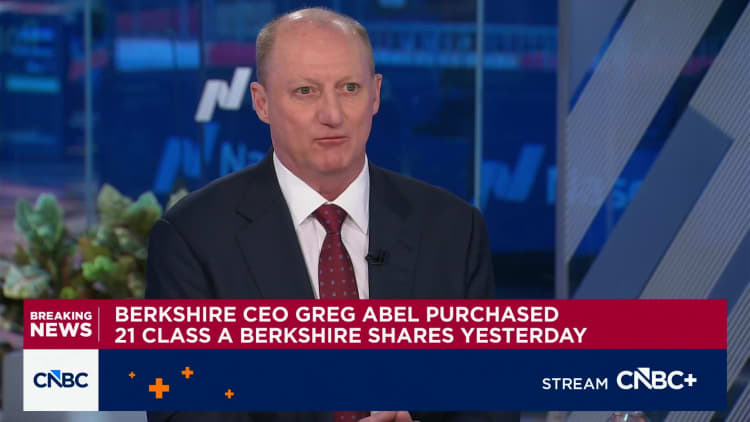
A second SEC filing that morning shows he started his annual purchases on Wednesday by paying $15.3 million for 21 Class A shares at an average price of $728,970 per share.
He also revealed Berkshire has no plans to sell some or all of its $7.9 billion Kraft Heinz stake now that the food company’s new CEO halted a plan to split the company in two.
Warren Buffett publicly criticized the proposed move when it was announced last September. And just a month ago, Abel indicated there could be a reduction or elimination of Berkshire’s KHC position with an SEC registration for “the potential resale” of almost its entire position.
Here are the details and some other highlights.
‘This is a one-time event’
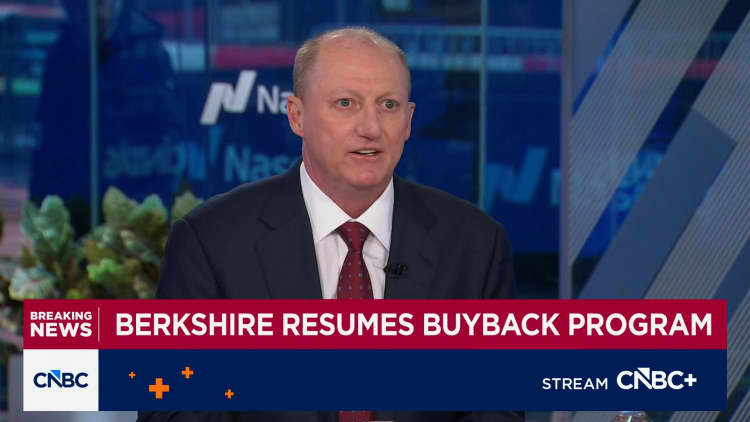
Berkshire’s announcement that it resumed share buybacks this week for the first time since May of 2024 appears to be all we’re going to get on the subject for the foreseeable future.
The SEC filing says the disclosure was made “in the interest of transparency with our leadership transition,” and warns “Berkshire does not undertake any obligation to update or revise any disclosures regarding our repurchases, including any suspension or termination of the repurchases,” expect in its regular quarterly financial reports.
The filing did not include any further details on how many shares had, or will be, repurchased, simply repeating the company’s “long-standing” policy that permits buybacks “at any time we believe the repurchase price is below our intrinsic value, conservatively determined.”
In his “Squawk” interview, Abel had nothing to add, despite prodding from co-anchors Becky and Joe Kernen, except to say he “absolutely talked” to Buffett about the move and it was made after the 48-hour “cooling off” period following the release of Berkshire’s 10-K annual report on Saturday.
“This is a one-time event to let our shareholders know.”
Abel will use his ‘entire’ salary to buy Berkshire shares every year
Abel revealed for the first time in the interview that he’s making a long-term commitment to personally buy Berkshire stock annually with his after-tax salary because “absolute alignment with our shareholders, our partners, our owners, is critical.”
“As CEO, I absolutely, obviously, believe in Berkshire, with the transition from Warren, and I inherited a company that has an incredible foundation. I believe in its future, the opportunities that exist there.”
Abel said both the Berkshire board and Buffett were “obviously very supportive” of his plan, with Buffett saying no one else in corporate America does this and it is “so Berkshire.”
“The whole idea is our shareholders are owners [who] use their after-tax dollars to buy Berkshire. I’ll do the same. So, Warren acknowledged immediately the alignment with our values.”
With the addition of the newly purchased stock, Abel owns 249 Class A shares with a market value of $185.8 million as of Friday’s closing.
According to the filing, he also owns Class B shares valued at almost $1.2 million.
No ‘immediate action’ on selling Kraft Heinz shares
Abel praised the decision last month by Kraft Heinz’s new CEO Steve Cahillane to pause plans for split the company in two, a division that would have essentially reversed the merger Warren Buffett helped orchestrate in 2015.
While Abel acknowledged there’s “no question” Berkshire’s investment in the food company has been “disappointing,” he had concerns about breaking them apart “when they’re facing a lot of challenges and haven’t resolved a lot of their issues yet.”
“So, for Steve to come in and say we’re pausing it, there’s opportunities within Kraft Heinz to fix things and get the business back on track and then he’ll evaluate things — we thought that was absolutely the right approach.”
Abel said the SEC registration was filed “really to be in a place that if we ever did sell, we’d be able to. But it’s not that we’re going to take any immediate action currently.”
Buffett is in the office every day
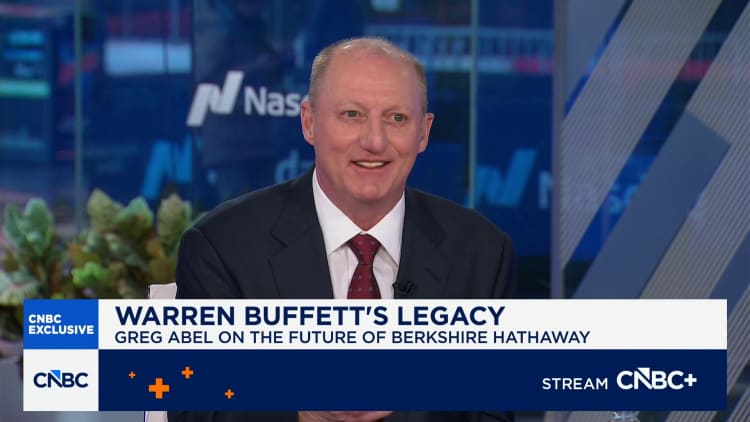
While Buffett is no longer CEO, he is still playing a significant role at Berkshire.
Abel reports that as chairman, Buffett still comes into the Omaha headquarters every day.
When he became CEO, Abel decided to continue to live in Des Moines, Iowa, but “if I’m in Omaha, we’re always connecting. If I’m traveling … I often check in just to catch up on what he’s seeing, what he’s hearing, what am I feeling.
“So, if it’s not every day, it’s every couple days.”
Can Abel get a major deal done in three days as Buffett did?
“We will act very decisively and quickly.”
Could there be a dividend after years of Buffett rejecting the idea?
“We don’t see it in the near future because we’re clearly meeting” Buffett’s long-standing policy that “we will retain a dollar if we see the opportunity to create more than a dollar for our shareholders.”
(It appears Abel shares Buffett’s belief that there will always be opportunities to use a dollar to make more than a dollar.)
Is there any chance Berkshire could pursue a crypto or blockchain opportunity?
“I don’t think you’ll see crypto” associated with Berkshire.
Ever? “I just don’t see it.”
Berkshire shares regain some ground after earnings decline
Berkshire shares fell almost 5% on Monday after the company reported Saturday morning that operating earnings dropped more than 29% during the fourth quarter, although Barron’s estimates that after adjusting for a noncash goodwill impairment loss of $1.6 billion and other one-time factors, the drop is closer to 20%.
Some investors were also disappointed Greg Abel’s shareholder letter did not include any specific plans to reduce Berkshire’s cash position, with some hoping in vain for a dividend.
The stocks erased some of those losses to end the week down around 1.2%.
CNBC.com’s Yun Li quotes Keefe, Bruyette & Woods analyst Meyer Shields as saying he views “both the resumed share repurchases and Greg’s commitment to annual buying as positives, but they don’t change the earnings challenges at units like GEICO or Berkshire Hathaway Reinsurance.”
Gabelli Funds portfolio manager Macrae Sykes thinks “it’s great to see more economic alignment with shareholders after the announcement from Greg about future stock purchases.”
Cathy Seifert at CFRA Research calls the resumption of buybacks “positive,” but “at this juncture my view is that Berkshire’s Class B shares are fairly valued, particularly given the tepid financial results.”
The whole thing
The entire 31-minute interview with Greg Abel is available in video form for CNBC Pro subscribers.
There is also audio of the entire conversation in the latest “Squawk Pod.”
BECKY QUICK: Good morning, everybody, and welcome back.
We have some breaking news right now coming from Berkshire Hathaway. The company has just filed a Form 4 and an 8K.
And joining us to talk about those topics and his first letter to shareholders after taking the reins from Warren Buffett is Berkshire Hathaway’s CEO Greg Abel.
Greg, welcome. It is great to see you this morning.
GREG ABEL: It’s great to be here. Good morning, Becky. Morning, Joe.
QUICK: We really appreciate your coming on set. We have so much to talk about.
But let’s jump in with the news that is just crossing the wires, and that’s what’s coming from the 8-K. That’s the big headline here, that Berkshire Hathaway has begun repurchasing shares of the common stock under the previous policy that had been out there before.
How many shares are you buying back? Why are we hearing about this?
ABEL: Yes, so we’ve had a longstanding policy that when the intrinsic value, as we see it, and computed on a conservative basis, when it exceeds our market price, Berkshire has always acquired shares. That’s been our longstanding policy.
We highlighted that in the 10-K and in my letter that that remained in place, and we’ve just recommenced yesterday.
So, the point being we see value, the intrinsic value exceeds the current market value, and we started — recommenced purchasing.
And we felt it was important to communicate to our shareholders, our partners, our owners, that with the transition of leadership and that this is the first time we’re purchasing shares, it was important to let them know we’ve recommenced.
QUICK: Yeah. The last time that you had bought back shares was May of 2024. Berkshire shareholders have long realized that it might be Charlie, maybe Warren, talking to each other, kind of figuring what they thought was a fair value for the price of things.
Did you talk to anybody about it, or you looked at it and you thought this is a good time to be buying back?
ABEL: No, I absolutely talked to Warren. So, how we — how I approached it was obviously looking at the value, having a view of intrinsic value, consulted with Warren relative to the value and the timing of is it ready to — are we ready to recommence?
And the thought there was after the consultation, we filed our 10-K, we —there’s a 70 — a 48-hour cooling off period Monday and Tuesday, and we commenced purchasing on Wednesday morning.
QUICK: Have you been looking at this for a long time?
ABEL: We look at it continuously.
KERNEN: What are the three top things that would make you think— is it something to the price of sales? Is it — what jumps out as a signal that the intrinsic value is not recognized by the share price? Which things?
ABEL: Well, what we always look at is what are the economic prospects of each of our companies in Berkshire. And we look at that over the long term.
KERNEN: Is it a gut feeling more than — are there numbers where you’d say, OK, this hit, you know, 80 percent of this part of Berkshire or something that —nothing that specific?
ABEL: It’s really just looking at the economic opportunities that exist within Berkshire and are we comfortable that the value proposition is very strong, and we’re doing it on behalf of obviously our shareholders and owners.
We have to view this as value, that we’re creating value for our shareholders long term.
KERNEN: So, if the stock goes up from the announcement or from the buybacks, how long would you do this? How much — will you keep doing it until it remains the case that you feel it’s undervalued? You can do as much as you want?
ABEL: Correct. As long as our intrinsic value exceeds the market value, again, conservatively determined, we’ll continue to repurchase.
But the one thing we have never done is we don’t disclose the amount, the timing, or the computation. But we did feel this time it was important because of the change in leadership that we should.
KERNEN: Not even a ballpark.
QUICK: So, we’re not going to hear something like this from you again. We won’t know when you’re in the market buying back?
ABEL: This is a one-time event to let our shareholders know.
KERNEN: And you won’t say it’s a $20 billion buyback and we’re halfway through? We won’t know anything.
ABEL: Correct.
KERNEN: Is that a reasonable number? Could it be — it could be a lot more at Berkshire.
ABEL: It’s completely dependent upon the intrinsic value and how that equation remains in place.
QUICK: So, Berkshire shares up until a minute ago were down maybe one percent over the last year. Market’s been up. You guys have $373 billion in cash as of the last filing.
ABEL: Correct.
QUICK: I guess you’re looking around, and it tells you that this is something that makes way more sense to you than buying other things —other stocks — making other purchases?
ABEL: Exactly. We always look at, effectively, three buckets when we’re allocating our capital.
We have our existing businesses, deploying capital back into those, both for their current operations and incremental opportunities. That really exists every day. And we’re constantly challenging ourselves, are we thinking about that properly?
As you highlighted, Becky, there’s also, do we acquire stock? And when we’re looking at companies, do we acquire whole companies also?
And then there’s the, do we acquire equities, other equities? And as we’ve highlighted, we always look at that as very similarly to buying 100 percent or two percent.
And then the third bucket where we deploy our capital is share repurchases.
Each of those with the amount of capital they have are — can be done independently. So, when we’re purchasing our shares, it’s not taking away from any of the other decisions.
QUICK: OK, we’re going to come back to this line of questioning and some of these issues here.
But before we do, I want to talk about another form that you put out today, too. That’s a Form 4. It may not jump out as people as being as significant as I think it is.
But in it, you say that you are buying 21 class A shares. This is the disclosure of that — $15.3 million dollars. What’s the significance behind that purchase?
ABEL: Yes. And the significance is if you look at my 2026 compensation that I’ll receive this year, what — what we’ve done is — and what I’ve done is taken the after-tax dollars of approximately $15.3 million dollars and reinvested it — or purchased Berkshire shares with the after-tax dollars.
QUICK: All of the extra — after-tax.
ABEL: All the after-tax dollars.
QUICK: So, you’re basically taking all of your take-home pay and putting it into shares of Berkshire.
ABEL: Yes.
QUICK: Why?
ABEL: And the why is really important.
One, as we’ve always highlighted, absolute alignment with our shareholders, our partners, our owners is critical. I already have some shares, but the goal was to continue to demonstrate alignment with them.
Two, as CEO, I absolutely obviously believe in Berkshire with — with the transition from Warren. And I inherited a company that has an incredible foundation. I believe in its — you know, future, the opportunities that exist there.
So, I was very excited to use my after-tax proceeds and my compensation, as you highlighted, all of it, and effectively do it as we came out of the blackout period.
Now, there is another part to this that’s really important, because I really view this more as a plan or an approach.
I’m committed to doing this every year going forward.
QUICK: Your entire salary?
ABEL: My entire salary, as long as I’m the CEO. And I touched on it in the — in the letter. I hope it’s 20 years. But I will do that.
So, we’ll file our 10-K. I’ll write the letter. And after the 48-hour cooling off period, I’ll purchase $15.3 million next year, whatever it is, after-tax dollars.
KERNEN: I love — I love the Midwest. But I was kidding you when you walked in, I said, as your first move, you’re going to Miami. You’re going to move the headquarters, Miami.
But now I understand. Leave it in — stay in Omaha. What are you going to spend your money on anyway? Might as well buy some Berkshire. You got nothing to do. You’re going to go out and watch some cows or something. That’s free, isn’t it?
ABEL: There’s nothing better than Berkshire. And it’s what I do every day.
KERNEN: That’s right.
ABEL: I wake up, you know, thinking about Berkshire. When I go to sleep, think about Berkshire.
KERNEN: Greg, if you decide to splurge on your compensation, it’s like you’re looking around — it’s like, ah, I’m going to buy Berkshire stock. (Laughter)
QUICK: What I think is interesting about this, Greg, is that you are effectively taking home less pay than Warren Buffett was when he was taking home $100,000. That was the salary that he took. It had to be the lowest pay in all of corporate America. Did he come up with this plan?
ABEL: No, this was completely myself. And by that, I just mean I wanted that alignment. Again, believe in Berkshire. And the thought being that — it did evolve. Like I said, OK, I’m going to do it this year. And then shortly thereafter, I thought, well, no, I’m going to do this every year.
And it’s best just to tell the world. And over that period of time, it’ll be hundreds of millions of dollars of — of my after-tax dollars, just like our shareholders do.
QUICK: I can’t imagine anybody, any other corporate leader doing this. I can’t imagine myself doing it.
KERNEN: I — I’m not worried about how you’re going to do on this either, so —
ABEL: Well, I believe in Berkshire. But it is interesting, Becky and Joe, you’re touching on it. Like, to me, of course, it’s a logical thing to do when you’re leading the company.
And there’s other leaders and CEOs that do the one-offs every once in a while. But to take all your after-tax dollars and to do it on a recurring basis.
KERNEN: I did something similar with Versant stock. I’m with you. I’m an owner. I’m an owner. And I — I —
QUICK: You did not take your entire —
KERNEN: I got a couple hundred shares. No, I didn’t. No, I didn’t.
QUICK: Greg, what did Warren say about this? What did the board say about it?
ABEL: Both were obviously very supportive.
Warren very much had your reaction, that no one else in corporate America does this. And said — and the other thing is that this is so Berkshire. Because one thing we — we do not do at Berkshire, across any of our businesses or with our executives, we don’t have equity stock programs.
QUICK: Right.
ABEL: We don’t have option programs.
QUICK: You’ve never been given a share of Berkshire, ever.
ABEL: Correct.
QUICK: Yeah.
ABEL: So, the whole idea is, our shareholders, our owners, use their after-tax dollars to buy Berkshire. I’ll do the same.
So, Warren acknowledged immediately the alignment with our values. And I highlighted this to our Berkshire board in our February board meeting, and they were just absolutely supportive of it, obviously.
QUICK: Greg, Andrew’s got a question, as well
ABEL: Yes, Andrew.
ANDREW ROSS SORKIN: Hey, Greg, it’s great to see you. I applaud it, too.
But I just — just to contextualize it, because we talked about selling shares, am I wrong, back in 2022, that you sold Berkshire Hathaway Energy and collected effectively $870 million? By the way, which I also applaud, but I just — contextually, what’s going on here in terms of your total — total compensation and what’s going into this?
ABEL: Correct. So — so, Andrew, back in the summer of 2022, there was the decision to sell my Berkshire Hathaway Energy stock that had really accumulated going back to 1992, I think, is the duration of those holdings. And obviously, we had built the energy company, we were acquired by Berkshire in 2000. And then in 2022, monetized it. And again, with a very similar concept, I took a portion of those proceeds on an after-tax dollar basis and purchased Berkshire stock.
QUICK: Yeah.
KERNEN: I bought — I’ll just say I bought a heck of a lot more than 21 shares. (Laughter)
QUICK: Twenty-one shares that cost $730,000.
KERNEN: Oh, that’s right. That’s right. Yeah. You’re right. You’re right. This was 32. OK.
QUICK: Greg, let’s talk through some other issues.
That $373 billion that you had on cash as of the last filing, do you see other opportunities? Are you looking for a big elephant — elephant hunting — as Warren always said he was doing?
ABEL: Right. So, I touched on it a little bit earlier, but the $373 million and —
QUICK: Billion.
ABEL: A billion, sorry. Thank you. And fortunately, it’s a billion.
We really view that as an opportunity. And so we do continue to look across the different investment options that exist out there. And there really are options. We’re looking at these different buckets and looking for the right opportunity.
But there is no need to — obviously, we want to deploy the capital into areas that we see long-term value creation for our shareholders. But the goal isn’t to just take down the amount.
QUICK: I guess my question is, do you see value out there in the market right now? Are things expensive as you weigh them? Or do you see pockets of opportunity?
ABEL: As we see opportunity, you’ll see the capital deployed. And we’re deploying it in certain areas across our businesses, across certain repurchases of our shares, across other equity opportunities.
But the repurchase of our own shares is a great example. Is that — Warner and I were just talking about discussing this yesterday. You know, we wish we could purchase more shares of our shares, but the intrinsic value has to be there.
So, if you go back over all the years that we’ve been purchasing shares, if we could acquire more, that’s a great use of our capital. But it has to meet that intrinsic value test.
QUICK: But that’s what I’m kind of getting at. You are now the person who’s going to be responsible for deploying all of this capital.
ABEL: Right.
QUICK: I guess Ted Weschler is there. He’s going to be — he has six percent. He’s managing his money and the money that Todd Combs was managing before, too.
ABEL: Right.
QUICK: But what is your view of the market at this point? It’s something we asked of Warren all the time. Do you think things are expensive?
If you think Berkshire shares — you’re going to buy back some, but you’re not going to deploy everything. You’d love to buy back more, but it’s not cheap enough. What do you think when you look at the overall market?
ABEL: Yeah. I mean, obviously we’ve commented on our shares. We file our — where we highlight what we’ve acquired and what we’ve disposed of, you know, regularly. And we have some activity there, but it’s not significant.
QUICK: Yeah. Are you — I guess are you reading through 10-Ks and 10-Qs constantly and thinking, I’m looking for ways to deploy this? Or are you looking at things a little differently than maybe Warren did because you’re such an operator.
ABEL: No, perfect question. Thank you.
QUICK: Yeah.
ABEL: I’m an operator, but I love businesses and I love reading.
QUICK: Yeah.
ABEL: So, I do the same thing. I’m going through Ks, Qs, I’m looking at their — what are they saying about their businesses. I’m looking at the industries that we — we traditionally look at, and incrementally, to make sure, one, have a thorough understanding of the industries, what businesses stand out there.
It doesn’t mean it’s an immediate — that there’s an immediate value proposition there to acquire it, but that doesn’t mean — or a portion of the business — but it doesn’t mean it won’t be there a month from now or three months.
So, I view a lot of it [as] preparation, waiting for when we see that opportunity that the value exists within a specific opportunity.
QUICK: You said you talked to Warren yesterday. How often do you talk to Warren Buffett?
ABEL: Yeah, Warren and I pretty much — he’s in the office every day. So, we’re talking every — if I’m in Omaha, we’re always connecting.
If I’m traveling like I was yesterday, I often check in just to — just to catch up on what he’s seeing, what he’s hearing, what am I feeling.
So, if it’s not every day, it’s every couple of days.
KERNEN: Greg, would you do these large positions in, like, S&P bets that Warren has done at times in the past? He sold a lot of puts, brought in billions of dollars in premium back in the — the early 2000s.
You’ve made some macro — Warren used to make macro calls, or at least hedging calls, on the overall industries, not just individual stocks. Would that continue with you?
ABEL: I mean, if we see the right opportunity, yes. But it’s not — it’s not a strategy.
KERNEN: He hasn’t done it as much lately —
ABEL: Right.
KERNEN: — I don’t think. But I don’t think he ever lost any money on any of those things, did he?
ABEL: No, not that I’m aware of. But I mean, as we all know, these financial markets have become more fine-tuned and those opportunities — excuse me — may or may not exist going forward, where you can see an opportunity and we would pursue or deploy capital. But if we saw an opportunity that — that made sense to us, absolutely.
KERNEN: How about you remember back in the financial crisis when major companies would say, “Warren, can you?” And he’d say, yeah, I’d be glad to step in. Here’s what you’ll do. Twelve percent preferred stock convertible into — yeah, eight, ten — Goldman’s — blue-chip companies that — it was like a no-brainer. If I could have done it, I would have mortgaged the house and gotten those terms if I could. Would you do that again?
ABEL: Absolutely. We look — (Laughter)
KERNEN: Yeah, let me think about it. (Laughter)
You can have some time if you want.
ABEL: No, we don’t need to pause on those. And — and, you know, we still — it’s not a distressed time, but we still receive those calls even today. Warren receives them, myself, maybe not in a distressed situation. And we look at them and we evaluate them.
But we’re always prepared to act, and we’ll act decisively and quickly.
QUICK: Can you act the same way Warren did, which would be to do a deal for tens of billions of dollars and basically get it done in three days, without necessarily telling the board until after the deal had been cut?
ABEL: Well, within that period of time, we — we have a very good process in place between Warren and I and our board as to how we’ll act as we have in the past and we’ll act very decisively and quickly.
QUICK: So, you can do a big deal without —
ABEL: In three days, yes. Well, I would always — we have certain parameters where I would make sure, for example, our lead director is aware of what we’re doing.
QUICK: OK.
ABEL: But it does allow me to act and act quickly.
QUICK: OK. What about the idea of a dividend? That was something that Warren Buffett’s never been a fan of. Would you potentially give a dividend back to shareholders if you don’t see other opportunities in the market?
ABEL: Yeah. And that’s really, as you know, we have our dividend policy in place and the thought — and it’s reviewed and approved by our board again on — on an annual basis and one that Warren has put forward every year.
And we’ve, we’ve maintained that — that we will retain a dollar if we see the opportunity to create more than a dollar for our shareholders. And that’s been the test.
And we — and as long as we meet that test, we would continue to hold the dollar because we believe we can create value for our shareholders long term.
Now, incremental to that, we do see the repurchases as an opportunity, effectively, to deploy — to return capital to our shareholders—
QUICK: Instead of dividends, you’re basically saying?
ABEL: Well, it’s part of it. So, if we didn’t meet that test, we do a dividend. But we do constantly look at the repurchase.
QUICK: I don’t think I’ve — that’s more than I think I’ve heard from Warren and Charlie in the past. Just the idea if you didn’t make that test, you’d do a dividend. Is that something you see in the near future?
ABEL: We don’t see it in the near future because we —
QUICK: OK.
ABEL: — we’re clearly meeting the test as we see it. But we’ve always stated if we don’t meet that test, that’s the time.
QUICK: So, basically what you’re saying is no change?
KERNEN: Correct.
QUICK: OK.
KERNEN: Could you ever see a time? (Laughter)
QUICK: Would you rather? (Laughter)
KERNEN: Warren — a lot of technology, he may not have been the first person there, but he — he finally did enter and he entered big — Apple, other — other companies.
Is there any chance that some type of blockchain, new technology, crypto-related, maybe not — maybe not bitcoin itself, maybe not — you know, ether or anything like that, but — but a company that builds out a blockchain that suddenly all the tokens are moving on this? It looks like the future.
Would that ever be a possibility or crypto would never be a word you’d see on a Berkshire — ?
ABEL: I don’t think you’ll see crypto —
KERNEN: Ever, in any —
ABEL: Well, ever is a long time, but I just don’t see it.
What I do see is that when it comes to technology, again, from even — from an operational perspective where we’re seeing how we use it, the impact it’s having, it does allow us to develop strong views and a better knowledge base around certain companies that are technology companies or how we’re using the technology. So, technology will always be on the table and looking at —
KERNEN: What could include some type of blockchain — ? No?
ABEL: I don’t know, because I haven’t seen anything that would make sense that there’s a value proposition where you see the asset and how it produces value.
KERNEN: Some people think it’s going to disintermediate the entire banking industry. You don’t want to just watch while —
ABEL: We’ll be happy with our hard assets and the companies we own at that time.
KERNEN: But not gold. But not gold. (Laughter)
What about gold miners? How about airlines? Where — where are you on that now? (Laughter)
Remember how many times Warren’s been in and out of that? Oh, my God. I’m in ’em, I’m out of ’em.
ABEL: I know this is one of your favorite topics.
We’re very happy that we own NetJets — (laughter) — and the service it provides to its great customers.
QUICK: Greg, let me ask you a couple of quick news questions.
First of all, back in January, Berkshire filed an SEC registration for the potential resale of up to 99.99 percent of the Kraft Heinz holdings that you own.
More recently, you did say that you supported Kraft Heinz’s CEO, the decision to pause on that plan split of the company. Have you made a decision about what to do with that investment?
ABEL: Well, we did announce, as I said, support for Steve pausing it.
QUICK: Yeah.
ABEL: And just for a little bit of background, as you know, when they first said they were going to split, we didn’t — we expressed concerns with it.
QUICK: You were vocal about it.
ABEL: Right.
QUICK: Yeah.
ABEL: Because they did — when they brought Kraft and Heinz together, the whole idea was that there’d be a lot of synergies, a lot of opportunities.
And then they announced — and it’s as I highlight in the letter, it’s been a disappointing investment. There’s no question.
At the same time to break them apart when they’re facing a lot of challenges and haven’t resolved a lot of their issues yet, we had concerns with that, including now adding dis-synergies to it.
So, for [Kraft Heinz CEO] Steve [Cahillane] to come in and say we’re pausing it, there’s opportunities within Kraft Heinz to fix things and get the business back on track and then he’ll evaluate things, we thought that was absolutely the right approach.
And we filed our registration — straight — statement really to be in a place that if we ever did sell, we’d be able to. But it’s not that we’re going to take any immediate action currently.
QUICK: OK, good.
Another issue this week, S&P said that it may own — it may cut PacifiCorp Utility, which is a Berkshire-owned utility, to junk because of the wildfires and the lawsuits that have been resolved about it.
This is another issue you touched on in your letter to shareholders. I think in the letter to shareholders, you basically said you accept responsibility for wildfires, but you’re going to fight unjustified claims in court. And you think that this is one of those situations.
ABEL: Correct. So, anytime we’re responsible for something, we’re willing to take absolute responsibility for it and resolve such matters.
But there is a delicate balance, and it goes well beyond wildfires in the utility industry. The wildfires are very specific to the West, and we’ve seen some challenges in Texas and the Midwest that, you know, it’s not an issue just to the West, but you can see it creeping.
But what we see is a bigger issue in the regular — in the utility industry, and that is, does the regulatory compacts continue to exist? And by the regulatory compact, I mean we deploy capital into these businesses. We were — we receive a return that’s reflective of us taking a certain amount of risk.
And the minute they start expanding that risk to be pretty much anything, including things you’re not responsible for, we’re saying that’s — that wasn’t the investment thesis. That’s not the relationship that existed.
QUICK: Just to put some context to this, this came after a February 25th ruling where an Oregon jury awarded $305 million to 16 plaintiffs. That’s about $19 million per plaintiff. Those plaintiffs blame PacifiCorp for not turning off the electricity.
ABEL: Right. And there were lessons learned because if you look — and that’s what we’re saying — when there are ones where we clearly cause a fire [by] not turning off the electricity, we’re taking responsibility for those.
But separately, there were a number of fires there. And this gets beyond. But — but there is one area and one fire we’re pushing back and it represents more than 60 percent of claims. It was a lightning strike.
And we’re just saying we’re not responsible for that. We’re sorry, absolutely, that these people’s lives have been impacted. We feel for them. But that’s not the utility’s responsibility to take on those costs and obligations. So, that’s where we’re drawing the line.
KERNEN: You guys know the insurance business pretty well, I think, don’t you? You know when you’re covered or things you need to cover and things that you can’t run a business if —
ABEL: Right. And it goes back to that regulatory compact. That’s not part of — we didn’t sign up for that.
QUICK: This was your first letter that you wrote. It was a long one. Eighteen pages or so. It’s — (Laughter)
KERNEN: Is that AI?
ABEL: No. (Laughter)
But I will say on the length, that’s the first response I get from everybody when they text me as they’re reading it.
KERNEN: Yeah.
ABEL: Jeez, this is really long and halfway through.
And I use this quote back to them. and it won’t be a perfect quote. But I — Lincoln — President Lincoln — said, yes, this letter is very long, but I didn’t have time to make it shorter. (Laughter)
QUICK: Was that hard?
ABEL: I use that to everyone because everybody would be texting me, I’m halfway through — but so far, it’s going well. (Laughter)
I text them that that quote every time.
QUICK: I mean, you’re stepping into some pretty big shoes. Warren’s been writing that letter for 60 years and it’s something that had a huge following. Was it tough letter to write?
ABEL: Absolutely. So, those are — there’s — those — the shoes to fill are tough on all fronts.
But Warren’s an exceptional communicator and how he does it.
So, to take the letter and really want to make sure we’re communicating to our — again, to our owners and shareholders — something that they would value. It was not easy.
I’ve told Warren of all the — listen, the responsibilities transferred are great. As far as the work and the task I had to do, that was the toughest to sit down and make sure that that was done, at least from my perspective, well.
And unfortunately, when I — when we were discussing it, he said, and the second letter doesn’t get any easier.
QUICK: So, you have that to look forward to.
ABEL: Yeah, exactly. That’s not what I wanted to hear. (Laughter)
KERNEN: Every year. And it’ll come fast, too. It’s like you just finish it like that, like — like taxes.
ABEL: But you know what when you —
KERNEN: Yeah, yeah.
ABEL: You know, when you do write it, it’s like everything, or when you prepare for something, it’s valuable.
KERNEN: Yeah.
ABEL: I had to reflect on a lot of things.
KERNEN: Right. And then when you’re done, it’s just leading into this.
ABEL: It’s leading into it, right. Exactly.
QUICK: Greg, very quickly.
ABEL: Yes.
QUICK: Operating income was down in the fourth quarter, more than 29 percent. That was largely because of weakness in the insurance business. And underwriting profits were down, I think close to 50 percent. What happened?
ABEL: Yeah. So, in the fourth quarter, which then translated for the 12-month results, is that, yeah, our insurance results were down. You can see a lot of capital coming into the industry.
We’re going to — we, or our team — Ajit and his team — will continue to apply the discipline that the price and the risk have to be right for us to write a policy.
So, as we back out of that with capital coming in, you’ll see those results be what they are relative to how much capital we deploy into it.
So, that had a significant impact.
And then the other piece of that is we did, across our non-insurance businesses, take a $1.555 billion dollar impairment. And that was across four of our businesses, and realistically, smaller businesses in challenged industries.
If it had been any of our major businesses, I would have touched on it. But it really related to four of our smaller businesses, again, and in industries that we see as challenged.
QUICK: Greg Abel, the new CEO at Berkshire Hathaway, sitting down with us for the first time today. We really appreciate it, Greg. And we look forward to seeing you at the annual meeting.
ABEL: Absolutely.
KERNEN: So, it’s not Creighton anymore, is it? Is it — do you have a team that you like in — March Madness is coming and —
ABEL: I’ll be — I’ll be — I’ll be cheering for — let’s just say, Joe, as you touched on earlier, all the Midwest teams.
KERNEN: All the Midwest teams. (Laughter)
QUICK: All of them.
ABEL: All of them.
KERNEN: All of them.
ABEL: We’ve got — you know, my wife’s from Iowa State. I have allegiances with Nebraska because I mentioned earlier my one grandfather was born in Unadilla, Nebraska. I’ve always followed the Cornhuskers. You name it. I’ve got a spectrum of teams. And my family reminds me of that — pick a team. (Laughter)
KERNEN: I would say it was looking good. And I bet on them. And that’s they were number four. Yeah, they lost the last two games, I think.
ABEL: Yeah, they’ve had a rough couple of games. Hopefully they find it. But it’s been a pleasure to be on. Thank you, Becky. Thank you, Joe.
KERNEN: Thank you.
ABEL: And it’s great to be here.
KERNEN: Don’t be — don’t be a stranger.
ABEL: Absolutely not.
KERNEN: Yeah, great to have you back. Thank you.
ABEL: Thank you.
BUFFETT & BERKSHIRE AROUND THE INTERNET
Some links may require a subscription:
BERKSHIRE STOCK WATCH
Four weeks
Twelve months
BRK.A stock price: $747,800.00
BRK.B stock price: $498.98
BRK.B P/E (TTM): 16.08
Berkshire market capitalization: $1,076,116,670,958
Berkshire Cash as of December 31: $373.3 billion (Down 2.2% from Sept. 30)
Excluding Rail Cash and Subtracting T-Bills Payable: $369.0 billion (Up 4.1% from September 30)
Berkshire resumed stock repurchases on March 4, 2025, but did not release any details.
(All figures are as of the date of publication, unless otherwise indicated)
BERKSHIRE’S TOP EQUITY HOLDINGS – March 6, 2026
Berkshire’s top holdings of disclosed publicly traded stocks in the U.S. and Japan, by market value, based on the latest closing prices.
Holdings are as of September 30, 2025, as reported in Berkshire Hathaway’s 13F filing on November 14, 2025, except for:
The full list of holdings and current market values is available from CNBC.com’s Berkshire Hathaway Portfolio Tracker.
QUESTIONS OR COMMENTS
Please send any questions or comments about the newsletter to me at alex.crippen@cnbc.com. (Sorry, but we don’t forward questions or comments to Buffett himself.)
If you aren’t already subscribed to this newsletter, you can sign up here.
Also, Buffett’s annual letters to shareholders are highly recommended reading. There are collected here on Berkshire’s website.
— Alex Crippen, Editor, Warren Buffett Watch
This post was originally published on CNBC Markets