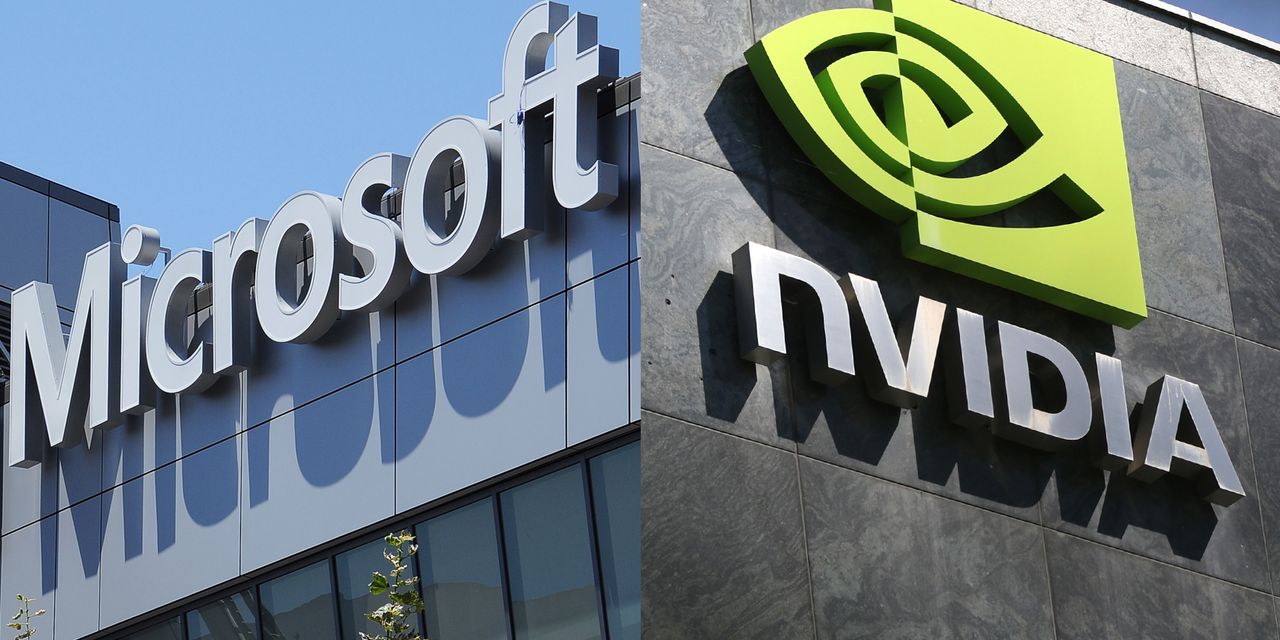
Microsoft Corp. and Nvidia Corp., two of the standard-bearers of the artificial-intelligence wave, along with another chipmaker and one cybersecurity company, jostled for record closing highs Friday, as AI remains a driving force in this year’s tech rally.
On Friday, Nvidia
NVDA,
shares rose as high as $480.88 and were last up 0.7% at $463.15, while Broadcom Inc.
AVGO,
shares hit an intraday high of $903.35 and were last up less than 0.1%, after Truist analyst William Stein said the two chip makers had the most upside in the AI chip market following positive industry feedback.
Nvidia and Broadcom were still on track for a record closes, compared with Thursday’s $459.77 and $890.36, respectively.
Read: Nvidia ‘should have at least 90%’ of AI chip market with AMD on its heels
Microsoft
MSFT,
shares, which had traded as high as $351.43 earlier in the session, had been on track to unseat the current closing high of $348.10 set on June 15 but were last up 1.1% at $346.37. They need a 1.6% gain on the day for a new record closing high.
Read: Amazon, Microsoft and Google cloud services bet heavily on AI, but do their customers even want it?
On Friday, UBS analyst Karl Keirstad hiked his rating on Microsoft to a buy and boosted his price target to $400 on AI enthusiasm.
Microsoft gained momentum earlier in the week after the company’s expanded cybersecurity offerings put pressure on pure-play cybersecurity vendors like Palo Alto Networks Inc.
PANW,
and Zscaler Inc.
ZS,
That did not stop Fortinet Inc.
FTNT,
shares from being on track for a record close, with its most recent being on Tuesday at $78.32. Like many other cybersecurity providers, Fortinet’s protection is augmented with some type of AI.
Meanwhile, Microsoft faces its own pressure to close its acquisition of Activision Blizzard Inc.
ATVI,
by July 18, after the Federal Trade Commission said it was appealing a federal judge’s decision to let the deal proceed.
Read: Opinion: Why the AI stock frenzy looks disturbingly like the PC and dot-com booms — and busts
This post was originally published on Market Watch